Drying to a reading
Structural Drying and Dehumidification in Wilmington, CA
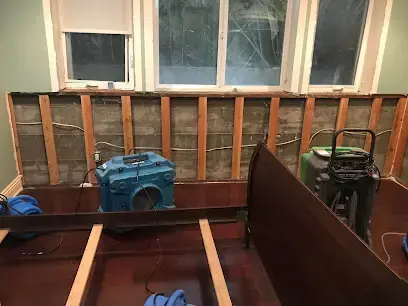
Surfaces dry in a day; framing, subfloor and concrete do not. The drying team sizes air movers and LGR dehumidifiers to each room and keeps them running until the readings say dry.
(888) 563-9619Need the house dried right? Call now- LGR dehumidifiers
- Psychrometric logs
- Within 2 to 4 points of dry
Right away
First steps for structural drying in Wilmington
- 1
Keep the house closed
Open windows let damp harbor air in and slow the dehumidifiers.
- 2
Leave the equipment running
Air movers and dehumidifiers work around the clock.
- 3
Keep doors as they are set
The drying team sets doors open or closed to steer the airflow.
- 4
Empty a reservoir if asked
Some units drain to a bucket, though most pump to a sink.
How the work runs
How the Wilmington crews approach structural drying
Rapid local response
The response team dispatches 24/7 across Wilmington and the harbor area, and active water is treated as urgent at any hour.
IICRC S500 drying standard
IICRC S500 is the industry drying standard: structural drying, not just surface drying, with equipment sized to each room.
Claim-ready documentation
Moisture maps, daily drying logs and timestamped photos taken before any demolition go into the claim file.
Local water know-how
Galvanized supply pipe, slab leaks, clay sewer laterals and winter storm runoff lead the calls across the harbor area and the South Bay.
What it usually costs
What does structural drying cost in Wilmington, CA?
In Wilmington, CA, structural drying typically runs $1,500 to $7,000, depending on the class of the loss, the number of rooms and the materials involved. Plaster, hardwood and slabs take longer and cost more.
Drying one area
$1,500 to $3,000
- Class 1 or 2 loss
- Air movers and one LGR unit
- Three to four drying days
Several rooms, walls opened
$3,000 to $7,000
- Wall cavity drying
- Several dehumidifiers
- Daily psychrometric logs
Class 4 or a whole floor
$7,000 to $14,000+
- Desiccant dehumidifiers
- Slab or plaster drying
- Extended monitoring
These are typical ranges, never a quote: the water category, the square footage, the material class and how fast drying started move the number most. The Wilmington water damage cost calculator gives a closer planning range, and the restoration contractor who responds sets the real scope after the walkthrough.
Structural drying is the part of a water loss nobody sees. After the standing water is gone, framing, subfloor, drywall, plaster and concrete still hold water that will not leave on its own in time. Damp harbor air slows natural drying in Wilmington, so dehumidification carries much of the work.
How structural drying works
The tech who does the walkthrough maps the moisture and sets the class of the loss, from Class 1 with little wet surface to Class 4 with dense materials like hardwood, plaster and concrete. The class sets how many air movers and how much dehumidifier capacity each room needs.
- Air movers sweep the wet surfaces so water evaporates faster.
- LGR dehumidifiers pull that water out of the air and send it down a drain.
- Desiccant dehumidifiers take on Class 4 materials and cool, damp conditions.
- Wall cavity and subfloor systems push air into spaces that surface drying cannot reach.
Readings, not guesses, end structural drying
The drying team records temperature, humidity and material readings every day, the psychrometric log that shows the job is moving. Equipment comes out when wet materials sit within 2 to 4 points of a dry reference material in the same house.
Drying framing promptly also protects the indoor air, and the EPA guide to indoor air after flooding explains why speed matters. OSHA flood cleanup guidance covers safe work around wet materials.
Structural drying in older Wilmington homes
Lath and plaster walls, old-growth framing and thick concrete slabs dry slower than modern drywall. The drying plan accounts for that, which is why a prewar bungalow often needs more days than a newer house. The first step on any loss is water extraction.
Step by step
The structural drying process in Wilmington
- 1
Classify
Moisture mapping sets the category and class.
- 2
Set
Equipment is sized to each room's evaporation load.
- 3
Log
Readings are recorded every day.
- 4
Release
Equipment leaves at the drying goal, not before.
Where the crews work
Structural drying across Wilmington and the harbor area
Wilmington Water Damage Restoration covers ZIP 90744 and 90748, from Avalon Boulevard and the waterfront along Harry Bridges Boulevard to Banning Park, Drum Barracks, the Anaheim Street corridor and the blocks near Los Angeles Harbor College.
Nearby coverage reaches Harbor City, San Pedro, Carson, Lomita, West Carson, Harbor Gateway, Long Beach, Rolling Hills Estates, Signal Hill and Torrance.
More water services
Related water damage services in Wilmington
Common questions
Questions about structural drying in Wilmington, CA
What does within 2 to 4 points of dry mean?
The drying team reads a dry piece of the same material in an unaffected part of the house. Wet materials count as dry when their readings sit within 2 to 4 points of that reference.
Why not just open the windows and run fans?
Fans move water into the air, and open windows let damp outdoor air back in. Dehumidifiers take the water out of the house, which is what finishes the job.
How long does structural drying take?
Most losses take three to seven days. Class 4 materials like hardwood, plaster and concrete take longer.
Is the drying equipment loud?
Air movers and dehumidifiers make steady fan noise and run day and night. The drying team places them to dry the room without blocking walkways.
What is an LGR dehumidifier?
A low grain refrigerant dehumidifier pulls more water out of the air than a household unit, even when the air is already fairly dry, which is why restoration crews use them.
Can drywall be dried instead of replaced?
Often, when it was wet with clean water and drying started early. Contaminated, sagging or crumbling drywall is removed.
Emergency dispatch, Wilmington, CA
Water damage in Wilmington that will not dry? Get readings taken now.
Hidden water in framing, subfloor and concrete outlasts the surface water by days. The drying team sizes equipment to the loss and logs it to the goal.